
Popcorn Ceiling Removal vs Skim Coating Compared

Best Drywall Finish for Modern Interiors
8 julio, 2026
How Professionals Skim Coat Drywall Walls
12 julio, 2026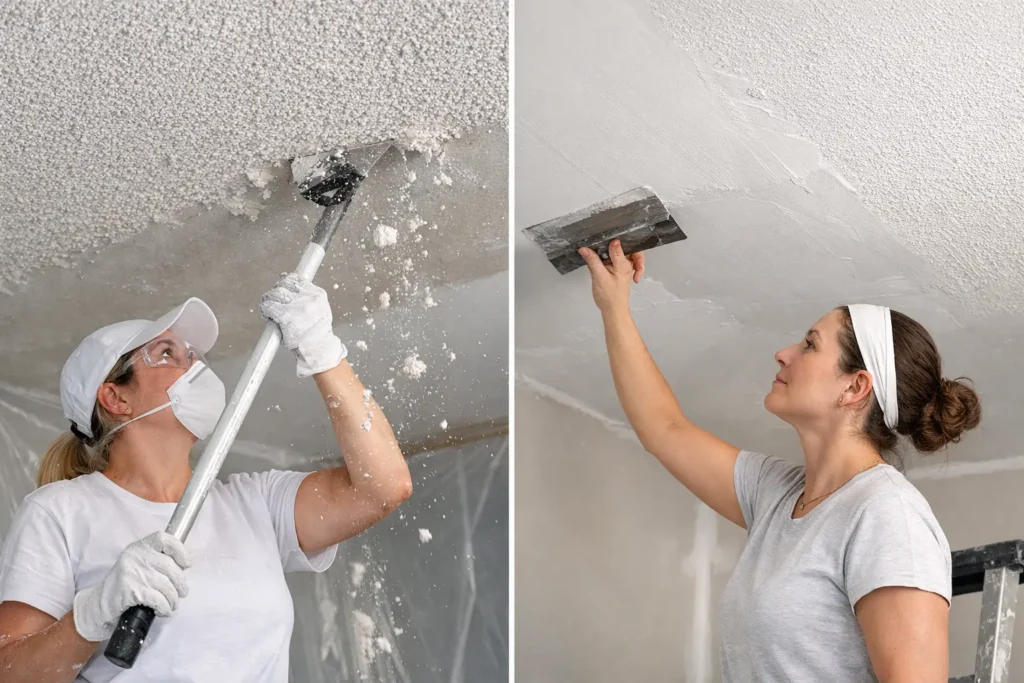
A dated popcorn ceiling can make an otherwise updated room feel unfinished. When homeowners compare popcorn ceiling removal vs skim coating, the real question is not simply which option costs less. It is which process will leave the ceiling clean, durable, and ready for the finish you want.
Both approaches can lead to a smooth-looking ceiling, but they solve different problems. Removal takes the existing texture off. Skim coating covers and levels it under new layers of drywall compound. The best choice depends on the texture’s condition, previous paint, ceiling repairs, access, and how high you want the final finish standard to be.
What Popcorn Ceiling Removal Involves
Popcorn ceiling removal means softening or mechanically removing the existing textured material, then preparing the exposed ceiling surface for repair, finishing, primer, and paint. When the texture comes off cleanly, this approach eliminates the old material rather than burying it.
The process often reveals what is underneath: drywall seams, nail pops, old patches, water stains, uneven joints, or areas that were never finished to a paint-ready standard. That is not necessarily bad news. It gives a professional finisher the opportunity to correct those issues before creating a smooth ceiling.
Removal is often the stronger choice when the popcorn texture is loose, damaged, heavily stained, or starting to separate from the ceiling. It is also a practical option when you want to inspect the substrate after a leak or when a previous repair is visible through the texture.
The trade-off is mess and preparation. Popcorn removal can create dust and debris, especially if the ceiling has been painted and cannot be softened easily. Floors, walls, vents, fixtures, and furniture need careful protection. A proper crew plans for containment and cleanup instead of treating it as an afterthought.
When removal makes the most sense
Removal is usually worth considering if the texture is in poor condition, the ceiling has multiple visible patches, or you want the old finish completely gone. It can also be the better route if you are renovating the room anyway and already have protection, painting, electrical work, or other trades scheduled.
A ceiling with unpainted popcorn texture may be more straightforward to remove than one coated with several layers of paint. Painted texture can be stubborn, and aggressive scraping may damage the drywall board beneath it. This is where experience matters. The goal is not just to get texture off. It is to preserve the surface well enough to achieve a clean final finish.
What Skim Coating a Popcorn Ceiling Involves
Skim coating uses thin, controlled layers of drywall compound to cover the texture and build a level surface. The ceiling is prepared first, then compound is applied, dried, sanded, and checked under proper lighting. Depending on the texture depth and the condition of the ceiling, more than one coat may be needed.
This approach can reduce the disruption of scraping and can be a smart solution when the existing popcorn is firmly bonded and stable. Instead of disturbing the texture, the finisher creates a new continuous surface over it.
Skim coating is not a shortcut when it is done correctly. High spots may need to be knocked down first, cracks need proper repair, and the finish needs enough material and sanding to look uniform after paint. A rushed coat can leave shadows, ridges, sanding marks, or flashing that become obvious once daylight hits the ceiling.
For many homes, skim coating is a strong option when the texture is sound but visually outdated. It can also work well when a room needs a smooth ceiling with less demolition-related debris than full removal might create.
The limits of coating over texture
Skim coating should not be used to hide an active problem. If there is moisture damage, sagging drywall, loose popcorn, bubbling paint, or movement at the seams, those issues need to be addressed first. Compound cannot create a durable finish over an unstable base.
It also adds material to the ceiling. Usually, that added thickness is not visually significant, but it may matter around crown molding, recessed light trim, ceiling fixtures, or areas where the ceiling already has uneven transitions. A professional assessment can identify these details before work begins.
Popcorn Ceiling Removal vs Skim Coating: Key Differences
The choice between popcorn ceiling removal vs skim coating comes down to surface condition, project priorities, and the finish you expect after painting.
Removal gives you a fresh look at the drywall underneath. It is often the better long-term corrective approach when the existing texture is failing, stained, contaminated by past repairs, or too uneven to coat efficiently. It can require more containment and more repair work once the texture is gone, but it removes the old finish from the equation.
Skim coating preserves the existing texture as a base and creates a smooth finish over it. It can be less invasive in the right situation, especially when the popcorn is solid and the ceiling has no major defects. However, it depends on excellent surface preparation and careful application. If the ceiling has deep texture, loose material, or hidden damage, removal may deliver the more reliable result.
Cost also depends on the ceiling, not just the square footage. A simple, stable ceiling may be suitable for efficient skim coating. A ceiling with extensive repairs, heavy paint, difficult access, water damage, or lots of fixtures will require more labor regardless of which method is selected. A quote should account for preparation, repairs, protection, finishing level, priming, and cleanup – not only the first step.
The Finish Level Matters More Than Most Homeowners Expect
A smooth ceiling is one of the largest uninterrupted surfaces in a room. That means small flaws can stand out, particularly near windows, patio doors, pot lights, and modern directional lighting. The smoother the ceiling, the more important professional finishing becomes.
For standard rooms with normal lighting, a quality Level 4 finish is often appropriate before primer and paint. For spaces with critical lighting, darker paint colors, glossy finishes, or a premium design goal, a Level 5 finish may be the better investment. Level 5 adds a final skim coat across the entire surface to create a more uniform appearance.
This is why removing popcorn alone does not guarantee a beautiful ceiling. The final result is shaped by taping, repair work, skim coats, sanding, primer, and paint preparation. A ceiling can be texture-free and still look rough if the finishing work is not precise.
What to Check Before Choosing Either Option
Before committing to removal or skim coating, look closely at the ceiling’s condition. Water stains, cracks, peeling texture, patched areas, and sagging sections should be evaluated before cosmetic work begins. If moisture caused the damage, the source must be fixed first.
Age also matters. In older homes, popcorn ceiling material may need testing before it is disturbed. Do not assume a textured ceiling is safe to scrape based on appearance alone. Testing and proper handling help protect everyone in the home and keep the project moving responsibly.
Think about the room’s use as well. A vacant room undergoing a full renovation may be ideal for removal and more extensive repairs. An occupied bedroom, finished basement, or commercial space may benefit from a process planned around containment, access, and minimal disruption. There is no one-size-fits-all answer.
A Professional Plan Delivers a Better Ceiling
The best ceiling projects start with an honest assessment, not a generic recommendation. A skilled drywall finisher will evaluate adhesion, texture depth, paint layers, damage, lighting, and transitions around fixtures and trim. From there, the work can be scoped around the result you actually want: a clean, smooth, paint-ready ceiling that holds up over time.
TH Taping helps homeowners, property managers, and contractors in Niagara Region, St. Catharines, and Hamilton with popcorn ceiling removal, skim coating, drywall repairs, and high-quality finishing. Whether the ceiling needs a full reset or a carefully applied smooth coat, the focus should stay on precise preparation and a finish that looks right from every angle.
If your ceiling is holding back the rest of the room, request a free quote and get a clear recommendation based on its actual condition, not a one-method-fits-all sales pitch.