
Ceiling Crack Repair: Fix or Refinish?

Emergency Drywall Repair Done Right
17 mayo, 2026
Water Damaged Drywall Repair Done Right
19 mayo, 2026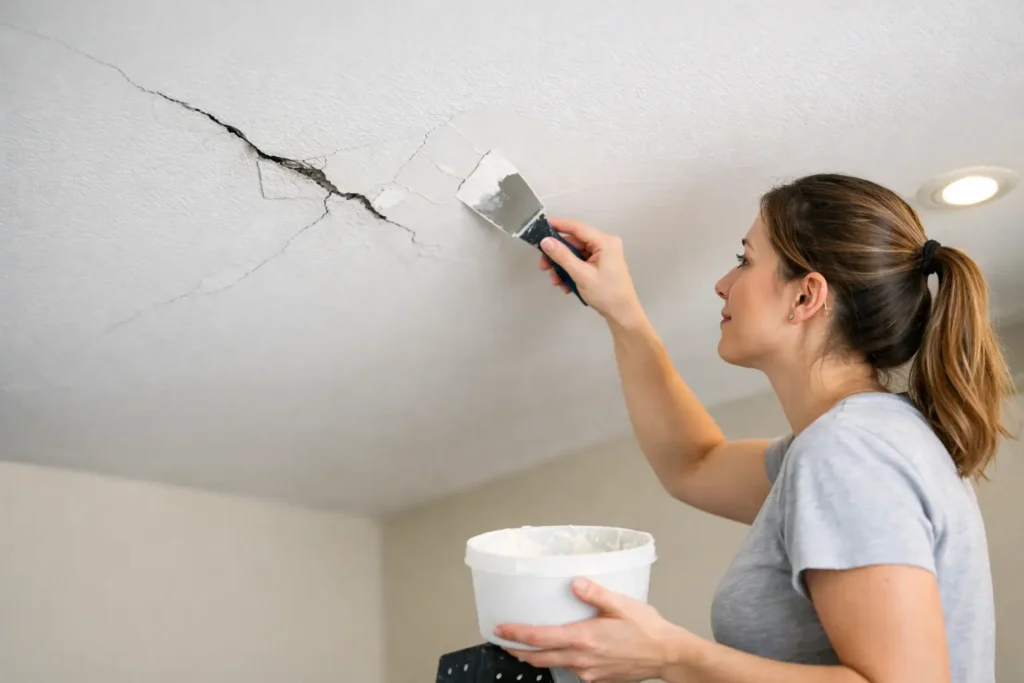
A ceiling crack usually shows up at the worst time – right after painting, before listing a home, or when a tenant points out a line that suddenly seems impossible to ignore. The real issue with ceiling crack repair is not just making the crack disappear. It is figuring out why it showed up, whether it will come back, and what kind of finish will actually hold.
Some cracks are cosmetic. Others are a sign that the joint was weak, the framing moved, moisture got involved, or the ceiling surface was never finished properly in the first place. If you patch the wrong way, the repair can flash through paint, reopen in a few months, or leave a visible hump across an otherwise clean ceiling.
What causes ceiling cracks in the first place?
Most ceiling cracks come from movement, stress, or poor bond at a joint. In drywall ceilings, that often means normal settling, seasonal expansion and contraction, truss uplift, or a taped seam that has started to fail. In older homes, plaster ceilings can crack as the material ages or loses support.
Hairline cracks that run in a straight line often follow a drywall seam. Spiderweb cracking can point to a surface issue, old paint failure, or a previous patch that was not done well. A wider crack, a crack that keeps growing, or one paired with sagging, staining, or soft drywall deserves a closer look before any cosmetic repair starts.
That distinction matters. A clean finish depends on treating the cause, not just the symptom.
When ceiling crack repair is simple
If the crack is narrow, stable, and limited to a drywall seam with no water damage or sagging, repair is usually straightforward. The damaged area is opened enough to remove loose compound, then retaped, mudded in layers, sanded, and blended into the surrounding ceiling.
This is where many DIY repairs go sideways. People try to force compound into the crack and paint over it. It may look acceptable for a week, but the crack line often prints back through because there is no real reinforcement behind the patch.
A durable repair usually needs tape, not just mud. Paper tape or a strong crack repair tape helps bridge movement better than compound alone. The finish then has to be feathered wide enough that the repair disappears under primer and paint instead of creating a ridge you notice every afternoon when the light hits it.
When a crack means more than a patch
Not every ceiling crack should be treated like a minor touch-up. If the crack is wider than an eighth of an inch, changes shape, runs across multiple sections, or appears near a ceiling sag, there may be structural movement or substrate failure behind it.
Moisture is another red flag. If the area is stained, soft, bubbled, or crumbly, the first step is not finishing work. The source of water has to be fixed, the damaged material has to be assessed, and any compromised drywall may need to be removed and replaced.
There is also the finish issue. In some homes and commercial spaces, the crack sits in a ceiling that already has multiple old patches, uneven texture, or visible seam lines. In that case, repairing one crack may solve the immediate damage but still leave the ceiling looking inconsistent. Sometimes a broader skim coat or full refinish is the cleaner long-term decision.
Ceiling crack repair on smooth ceilings
Smooth ceilings are less forgiving than most walls. Even a technically sound patch can stand out if the finish is not blended carefully. Light travels across ceilings differently, and shallow imperfections show fast, especially near windows, pot lights, and open-concept spaces.
For that reason, ceiling crack repair on a smooth ceiling is often more about finishing discipline than filling the crack itself. The repair has to be flat, properly sanded, and integrated into the surrounding field. Primer matters. So does paint matching. If the existing ceiling has any sheen at all, even a good patch can show if the final surface is not consistent.
This is one reason many property owners choose professional help for ceiling work even when the damaged area looks small. Overhead repairs are harder to control, and a ceiling that is almost right still tends to look wrong.
Why some repairs keep cracking again
Recurring cracks usually come from one of three problems. The first is movement that was never addressed. The second is a weak repair method. The third is poor finishing technique.
If the ceiling joint is moving seasonally, a thin skim of compound will not stop it. If loose material was left in place, the new mud is only bonded to failing mud. If mesh, paper, or compound was used carelessly, the repair can telegraph through or reopen.
There is also the issue of repair width. A narrow patch may technically cover the crack, but if the surrounding area is uneven or the seam has shifted, the eye will still catch the line. A better repair sometimes means going wider than expected so the ceiling looks uniform again.
That trade-off is worth understanding. A smaller repair may save time up front. A wider, more deliberate repair usually gives a cleaner final result.
Fix or refinish? How to decide
If the ceiling is otherwise in good condition, one stable crack can often be repaired without touching the whole surface. That makes sense for newer drywall, isolated seam failure, or localized cosmetic damage.
If the ceiling has several cracks, visible joints, patched spots, or uneven texture, a broader refinish may be the better investment. That could mean skim coating a larger section or refinishing the full ceiling to create one consistent plane. For homeowners preparing to paint, sell, or update an interior, this often produces a noticeably better result than chasing one imperfection at a time.
Commercial spaces have their own version of this decision. If appearance standards are high and the ceiling is under direct lighting, isolated repairs can stand out. In those settings, a wider finish scope may be the only way to maintain a professional look.
What a professional repair should include
A proper repair starts with assessment, not assumptions. The crack pattern, ceiling type, past repairs, moisture history, and final finish expectations all matter. Once the cause is understood, the repair can be built to last.
That usually means removing unstable material, reinforcing the area correctly, applying compound in controlled coats, sanding without scarring the surrounding surface, and priming before paint. On higher-end finishes, the repair may need skim work beyond the crack itself so the surface reads clean from every angle.
For clients who care about the final look, this part is just as important as the structural part of the patch. A ceiling can be repaired and still look repaired. The goal is a finish that does not call attention to itself.
When to bring in a specialist
If the crack is recurring, visibly wide, associated with water damage, or located in a high-visibility smooth ceiling, it is smart to get it looked at before trying a quick fix. The same goes for occupied rental units, commercial interiors, or homes where the repair needs to blend into a premium finish.
A specialist in drywall taping and finishing brings a different level of control to ceiling work. That matters when the surface has to be flat, durable, and paint-ready, not just patched. For property owners in Niagara, St. Catharines, or Hamilton who want the repair done cleanly and with minimal guesswork, TH Taping is here to help.
Ceiling cracks are common, but they should not be treated casually. The best repair is the one that fits the cause, the surface, and the standard you expect when you look up after the paint dries. If the ceiling matters to the room, the finish matters to the repair.